

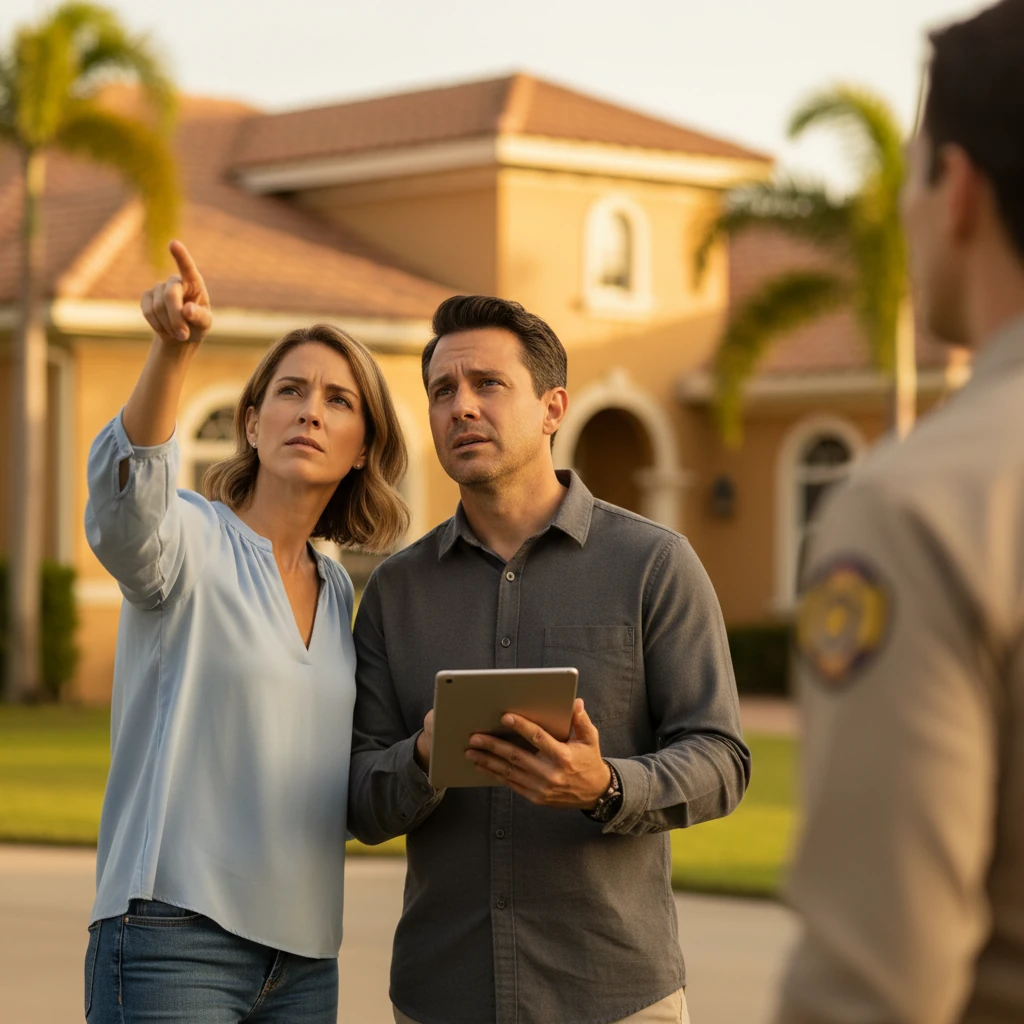
Wind Mitigation Inspection Florida
Licensed wind mitigation inspection using Florida form OIR-B1-1802. We document hurricane-resistant features; the carrier applies credits. Same-day reports in Miami-Dade, Broward, and Palm Beach. New to insurance inspections? Read our Florida insurance inspection guide.
How it works
-
Call or book online
We answer. Same-day and next-day slots are often open.
-
We inspect — you're welcome
Come along and ask anything.
-
Report the same day
A digital PDF with photos, sent to you — and to your agent if you want it there.
What the form documents
- Roof covering: material, age, installation, permit history.
- Roof geometry: hip vs gable percentages for credit eligibility.
- Roof deck attachment: fastener size/spacing, decking type.
- Roof-to-wall connections: straps, clips, wraps, or toenails.
- Secondary water resistance (SWR): peel-and-stick or equivalent layers.
- Opening protection: impact windows/doors, shutters, garage door bracing, glazed openings.
- Garage doors: reinforcement, wind rating labels where present.
We complete the official form accurately. The carrier decides which credit category applies.
Process and Timeline
- Duration: 45-60 minutes on-site for most properties.
- Report: Completed OIR-B1-1802 form with labeled photos delivered the same day.
- Preparation: ensure attic access, breaker access, shutter storage access, and key wind feature labels are reachable.
- Bundle: same visit as a 4-point when the agent wants both (posted bundle $200).
- Renewals: OIR says the form is valid up to five years if no material changes are made and no inaccuracies are found. Re-inspect after a reroof or new openings so the file matches the house.
Local Expertise for South Florida Homes
- Miami-Dade: High-wind zone focus on uplift resistance, tie-downs, and impact protection coverage.
- Broward: Frequent insurance reviews after storm seasons; we help document improvements quickly.
- Palm Beach: Roof shape and SWR details are what we document on coastal properties; the carrier applies any credit.
- Older homes: We note retrofit opportunities (clips/straps, shutters, underlayment) so you can plan work and a follow-up 1802.
What usually moves the file
- Impact openings + hip roof + SWR: features many Florida carriers score in their highest credit categories. The carrier applies the credit.
- Straps/clips + rated shutters: recorded when full impact glazing isn’t installed; credit is the carrier’s table.
- After upgrades: add secondary water resistance, garage-door bracing, or roof-to-wall hardware, then re-inspect so the form matches the house.
- Documentation: labeled photos for roof deck attachment, strap/clip type, opening protection labels, and roof geometry.
Green Foot wind inspections start at $100. We do not claim the inspection pays for itself in year one—that depends on the carrier’s credits.
County-Specific Hurricane Readiness
- Miami-Dade County: Miami, Miami Beach, North Miami, Sunny Isles Beach, and Aventura. Farther west or south is quoted per call.
- Broward County: Hallandale Beach, Hollywood, Fort Lauderdale, Pembroke Pines, and Miramar.
- Palm Beach County: West Palm Beach, Lake Worth Beach, Boca Raton, Jupiter, and Wellington.
We tailor the OIR-B1-1802 details to what carriers flag most in each county. See our service-area cities.
Complete Guide to Wind Mitigation Inspections in Florida
Understanding Wind Mitigation Inspections
A wind mitigation inspection records hurricane-resistant construction on Florida’s Uniform Mitigation Verification Inspection Form (OIR-B1-1802). Inspections on or after April 1, 2026 use Rev. 04/26. Florida Statute 627.0629 requires insurers to offer actuarially reasonable wind credits; we document the house, and the carrier applies its table.
How Wind Mitigation Credits Work
Credits usually apply to the windstorm/hurricane portion of the premium—not automatically to the whole bill. OIR forms OIR-B1-1699 and 1700 (credit ranges) are marked updates pending, so we do not publish a percent-off chart. Since October 1, 2023, each residential insurer must post hurricane-mitigation credit information on its website. That page, or your agent, is where your numbers live.
Features the form records include roof covering, roof deck attachment, roof-to-wall connections, secondary water resistance, opening protection (including garage doors), roof geometry, and—on Rev. 04/26—FORTIFIED certificates, design-wind region, and roof slope where required. Combined credit is the carrier’s math, not a Green Foot promise.
What Gets Inspected During a Wind Mitigation Inspection
Our wind mitigation inspections follow Florida's OIR-B1-1802 form requirements and examine:
- Roof covering: Material type, age, condition, and attachment method (nails vs. staples, spacing).
- Roof-to-wall connections: Presence and type of metal straps, clips, or other connections securing roof to walls.
- Roof deck attachment: How the roof decking is attached to framing (nails, staples, spacing).
- Secondary water resistance: Presence of underlayment systems designed to prevent water intrusion.
- Roof geometry: Hip vs. gable roof design and its impact on wind resistance.
- Opening protection: Windows and doors with impact-rated glazing or approved shutters/panels.
- Garage door: Wind load rating and reinforcement compliance.
- Roof shape: Hip, gable, or other configurations affecting wind uplift resistance.
We document findings with labeled photos and complete the official OIR-B1-1802 so the carrier can apply credits from its rate filing.
Understanding the OIR-B1-1802 Form
OIR-B1-1802 is Florida’s Uniform Mitigation Verification Inspection Form, adopted by the Office of Insurance Regulation under Rule 69O-170.0155. Inspections on or after April 1, 2026 use Rev. 04/26. Florida Statute 627.711 requires admitted insurers to accept a valid form signed by an authorized inspector. The form includes:
- Property information: Address, construction date, square footage, and property type.
- Roof system details: Covering material, attachment method, deck attachment, geometry, and secondary water resistance.
- Opening protection: Type and coverage of impact-resistant windows, doors, and shutters.
- Structural connections: Roof-to-wall connection type and installation details.
- Photographic documentation: Labeled photos showing key features and installation methods.
- Inspector certification: Licensed inspector signature and credentials.
The carrier uses this form with its own credit table. OIR states the form is valid for up to five years provided no material changes are made to the structure and no inaccuracies are found. After a reroof or new openings, get a new inspection so the file matches the house. Surplus-lines and private carriers can still ask for their own extra documentation—confirm with the agent before you order.
Source: Florida OIR wind mitigation resources (OIR-B1-1802; Rule 69O-170.0155, F.A.C.; Fla. Stat. 627.711 and 627.0629).
Features on the form (no invented percents)
We photograph and check the boxes the 1802 requires. Opening protection, hip vs. gable, clips vs. wraps vs. toenails, deck nailing, and SWR all matter for credits—but the percent is the insurer’s filing. Partial opening protection is documented as partial.
When to Get a Wind Mitigation Inspection
A current OIR-B1-1802 is useful when:
- New insurance application: the agent can submit documented features with the application. Credits, if any, come from that carrier’s table.
- Policy renewal: if the house changed (new roof, impact windows, straps), an updated form matches what is installed.
- After renovations: major work should be re-documented so the file is not describing the old house.
- Home purchase: buyers can see what is installed before the carrier prices the wind line. We do not quote a premium dollar savings.
- Form age: OIR says the form is valid up to five years if nothing material changed and no inaccuracies are found. Confirm the carrier still accepts the existing copy.
- First inspection: many homes have never had an 1802. We document what is there; the carrier decides the credit.
Documenting Wind Mitigation Features
To document a stronger file, contractors typically improve opening protection, roof-to-wall hardware, deck attachment, SWR (often at reroof), and garage-door rating. We re-inspect after the work. We do not quote a payback period or a percent off premium.
The report states what we verified. Your agent uses it with the carrier’s credit table.
Comprehensive Wind Mitigation Inspection FAQs
Yes. Inspections on or after April 1, 2026 must use OIR-B1-1802 Rev. 04/26. Citizens still accepts Rev. 01/12 if it was completed within five years before that date and the structure is unchanged.
Florida law requires insurers to offer actuarially reasonable wind credits (Fla. Stat. 627.0629). We complete OIR-B1-1802; the carrier applies its table. We do not quote a percent or dollar savings.
We complete Florida’s Uniform Mitigation Verification Inspection Form (OIR-B1-1802). Inspections on or after April 1, 2026 use Rev. 04/26. Admitted insurers must accept a valid form signed by an authorized inspector (Fla. Stat. 627.711). We document roof, openings, and connections with labeled photos. The carrier applies credits. OIR says the form is valid up to five years if no material changes are made and no inaccuracies are found.
We do not quote premium dollars. The form documents features; your declarations page after the carrier endorses the policy is the proof. Green Foot wind inspections start at $100.
After a new roof, the old 1802 may no longer match the house. We document deck attachment, secondary water resistance, covering, and connections as installed. The carrier applies credits from the updated form. We do not quote a premium dollar savings.
Older shutters may qualify if they have proper rating labels and provide the coverage the form requires. We verify labels, installation, and what is actually covered. If they do not meet the category the form lists, we record that. Credit is the carrier’s table, not a Green Foot upgrade promise.
Wind mitigation inspections typically take 60-90 minutes, depending on property size and complexity. We examine the roof system, opening protection, structural connections, and document everything with photos. The inspection focuses on specific wind-resistant features rather than a comprehensive home evaluation. Reports and the OIR-B1-1802 form are delivered the same day, typically within 4-6 hours, so you can submit to your insurance company immediately.
Yes. Same visit as a 4-point, roof cert, or buyer inspection when scheduled that way. Posted 4-point + wind bundle is $200.
OIR states the OIR-B1-1802 is valid for up to five years provided no material changes are made to the structure and no inaccuracies are found on the form. Carriers may still want a new inspection after a reroof, opening-protection work, or other changes. Confirm with the agent. We do not quote a premium dollar savings.
We document what is installed, even when features are limited. Recommendations are about matching the house to the form categories—not a return-on-investment or a promised premium cut. The carrier applies credits from its table.
If you just bought the home, a new 1802 documents what is there for your carrier. A prior owner’s form may be expired, describe a different roof, or fail a new carrier’s rules. We do not quote a premium dollar savings.
Both can qualify as opening protection if they are rated and cover the openings the form requires. We record labels and coverage. Whether they earn the same credit is the carrier’s table.
Partial protection is documented as partial. The carrier—not a made-up 80% example—decides the credit. We photograph what is protected and what is not.
SWR is a secondary barrier under the covering, often a self-adhering membrane. We record it when we can verify it. Credit is the carrier’s table, not a Green Foot percent.
Clips, wraps, and straps are roof-to-wall hardware the 1802 classifies. Toenails are the weakest category we commonly see on older attics. Credit depends on the carrier’s table and how much of the roof we can verify.
A hip roof slopes on all sides; a gable has vertical ends. Hip geometry is generally more wind-resistant. We record the shape. We do not quote a percent off premium for hip vs. gable.
Florida Statute 627.711 requires admitted insurers to accept a valid OIR-B1-1802 signed by an authorized inspector. Credit amounts are each carrier’s rate filing. Surplus-lines and private carriers can still ask for extra documentation—confirm the carrier’s requirements before ordering.
Green Foot wind mitigation inspections start at $100. The 4-point + wind bundle is $200. Larger or limited-access properties may quote higher.
No. The OIR-B1-1802 must be signed by an authorized inspector listed in Florida Statute 627.711—for home inspectors, that includes the required hurricane-mitigation training. Carriers do not accept a self-completed form. We inspect in person and complete the official form; the carrier applies credits.
We serve these cities
Wind mitigation inspections across Miami-Dade, Broward, and Palm Beach.
What Our Clients Say
Real reviews from South Florida homeowners. See all reviews.
Get the OIR-B1-1802 Documented
Schedule a wind mitigation inspection and submit the OIR-B1-1802 form the same day.